
Table of contents
Your customers depend on your product to do their work. Your business depends on it to earn revenue and retain their trust. Protecting customer data and keeping the service available are part of running that business.
That responsibility continues as the product and its cloud infrastructure change: a new API, a different cloud permission, another integration, a dependency update. Each change deserves a clear owner and a way to check that the controls still work.
SOC 2 examinations and penetration tests are valuable supporting measures. They provide assurance and help identify weaknesses. Their findings matter most when they inform the controls your team operates every day, from cloud posture and application access to incident response and recovery.
The useful question is: What detects and addresses a security gap as our product changes, and who owns the response?
What SOC 2 and penetration testing actually provide
SOC 2 is more than a collection of policies. A Type II report includes the auditor's opinion on the operating effectiveness of controls over the period covered, within the defined system and scope. Read the scope, exceptions and relevant customer responsibilities, not just the report's existence. It is an assurance report, not a promise that a future incident cannot occur. [1]
Penetration testing adds a different view. Authorized testers investigate weaknesses and demonstrate their impact within an agreed scope, method and testing window. The findings help a team improve its defenses. A test cannot establish that every possible vulnerability has been found, or that later changes will remain secure. NIST's testing guidance explicitly addresses the benefits and limitations of technical assessment methods. [2]
Keep both. Then connect their findings to the way the product is built and operated.
| Measure | Useful evidence | What still needs attention |
|---|---|---|
| SOC 2 Type II | An opinion on scoped controls over a defined period. | Later changes, exclusions and customer responsibilities. |
| Penetration test | Demonstrated weaknesses within the agreed scope and window. | Untested paths, new releases and verification of fixes. |
| Ongoing product security | Change checks, triaged alerts, verified fixes and restore exercises. | Coverage gaps and periodic independent challenge. |
The gap is often in what happens next
Consider a hypothetical SaaS team that fixes every significant issue identified in its latest pentest. Two weeks later, a release introduces an API that checks whether a user is logged in but fails to check whether that user can access the requested customer's record.
A cloud configuration check might show that the database is private and encrypted. That is useful, but it does not prove the API enforces tenant isolation. The missing control is in the application.
Now consider a different change: an administrator accidentally makes a storage resource public. An application test may not detect that cloud configuration change. Cloud posture monitoring and a safe remediation process can help.
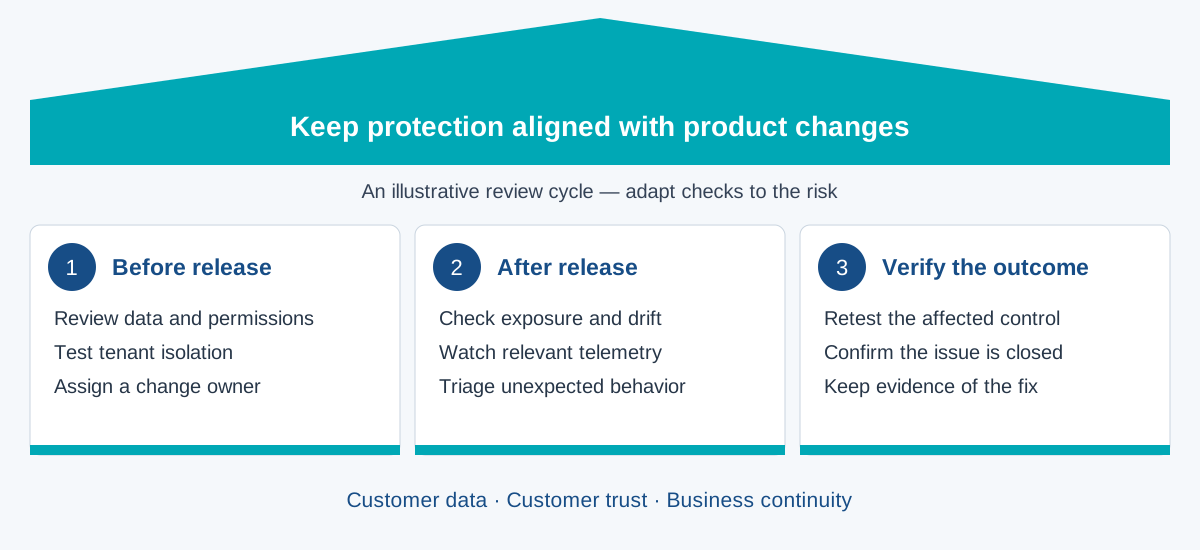
Neither example makes a breach inevitable. They show why the defense must match the failure mode, and why a report or a single tool cannot cover every layer.
A practical layered architecture
The following model is illustrative, not a deployed environment or a product specification. Adapt it to the data, cloud services, contractual obligations and operational capacity of the business.
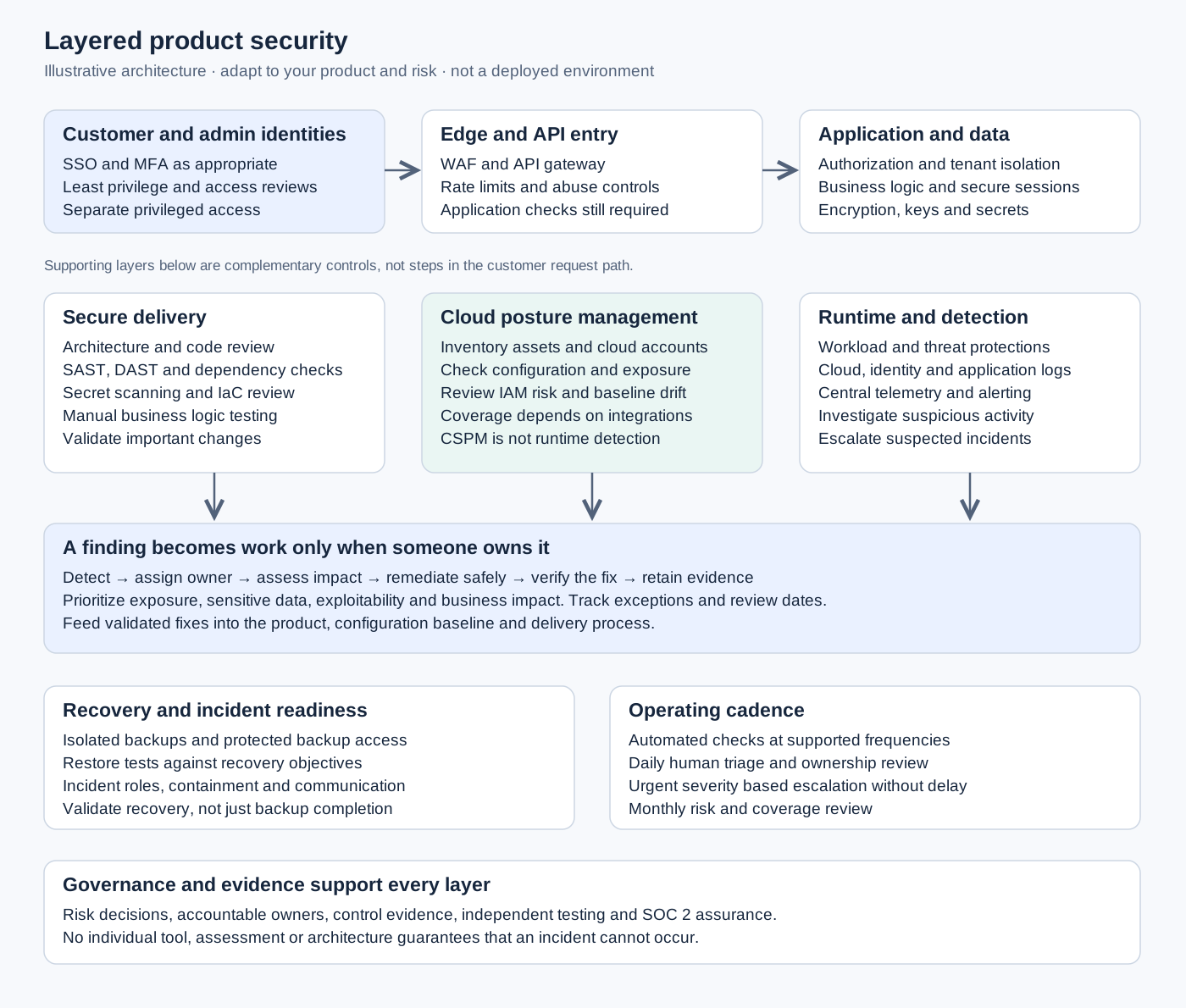
Identity: Use single sign-on where appropriate, multifactor authentication for privileged access, least privilege and a controlled process for granting and removing access. Separate administrative access from normal customer traffic.
Application and data: Put appropriate filtering and rate limits at the edge, but enforce authorization inside the application. Test tenant isolation and business logic. Protect data in transit and at rest, restrict key access and keep secrets out of source code. A WAF does not replace application-level access checks.
Secure delivery: Review architecture and changes before release. Combine code analysis, dependency checks, secret scanning, infrastructure-as-code review and dynamic testing according to risk. Use focused manual testing where automated tools cannot understand the business rules.
Cloud posture: Inventory the accounts, subscriptions and assets you operate. Use cloud security posture management, or CSPM, to identify risky configurations, excessive exposure and changes from your intended baseline. Microsoft describes CSPM as ongoing assessment and recommendations for cloud security posture. AWS documents checks that run on events or periodically. Coverage depends on the services, permissions, rules and integrations configured. [3][4]
Detection and response: Collect relevant identity, cloud, application and workload telemetry. Use threat detection and runtime protections suited to your environment. Route meaningful alerts to someone who can investigate and act. CSPM findings are not a substitute for detecting suspicious activity or responding to a compromised account.
Recovery: Maintain appropriately isolated backups, protect administrative access to them and test restores. Decide who coordinates an incident, how access can be revoked and how service will be restored. A backup job succeeding is not the same as a recovery exercise succeeding.
This broader view is consistent with NIST CSF 2.0, which organizes cybersecurity outcomes across Govern, Identify, Protect, Detect, Respond and Recover. [5] CISA's Secure by Design guidance also places responsibility for customer security outcomes within product design and leadership, rather than leaving protection entirely to customers. [6]
A dashboard needs an owner and a working loop
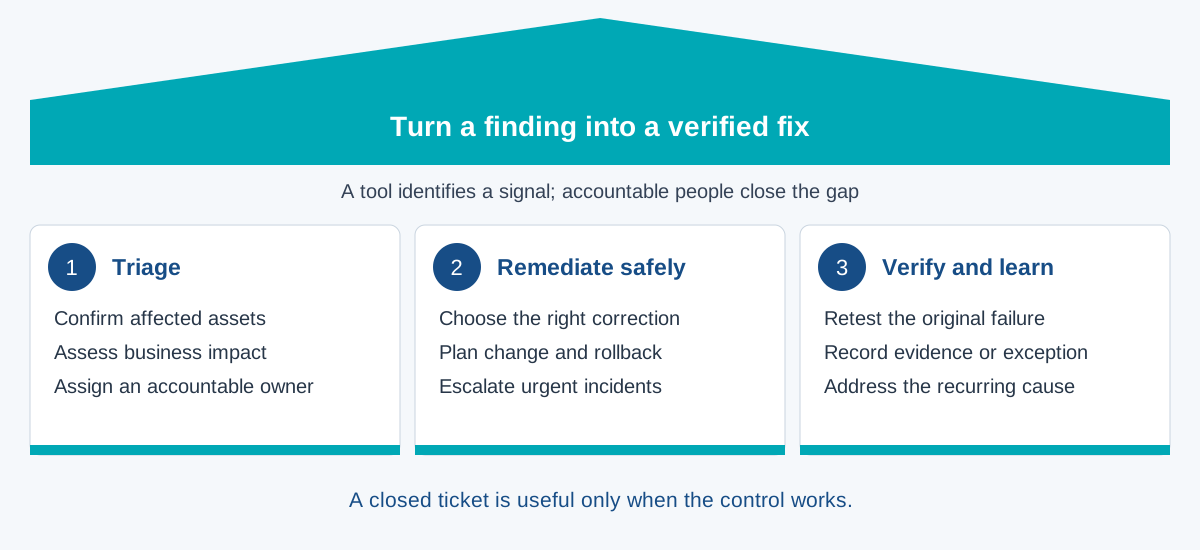
A finding should move through a clear sequence: detect, assign an owner, assess impact, remediate safely, verify the fix and retain evidence.
Prioritize using context: exposure to the internet, access to sensitive information, exploitability, privilege and business impact. Record accepted risks and exceptions with an accountable owner and a review date. Do not automatically change production merely because a scanner recommends it.
A practical operating cadence might look like this:
| Cadence | Purpose |
|---|---|
| Continuous or scheduled automation | Check supported configurations and assets, collect telemetry, and surface changes according to each tool's actual coverage and frequency. |
| Daily human triage | Review new findings, confirm ownership, investigate relevant alerts and check overdue remediation. This is not a substitute for urgent escalation. |
| Severity based response | Handle critical findings and suspected incidents through agreed escalation and response procedures. Do not wait for the next daily or monthly meeting. |
| Monthly risk review | Review recurring causes, exceptions, coverage gaps and business risk with accountable owners. |
| Change and risk based validation | Reassess material releases, permissions, architecture and integrations; schedule independent testing appropriate to risk and commitments. |
This is a planning model, not a universal schedule or a service-level promise. A team handling high-impact customer data may need different response coverage from a small, low-risk internal application.
Choose coverage before choosing another tool
There are several reasonable ways to operate this model.
| Approach | Best fit | Confirm before committing |
|---|---|---|
| Cloud-native tools + internal owner | Straightforward environment with staff capacity. | Who configures checks, investigates and completes fixes? |
| Broader security platform | Multiple environments and fragmented findings. | Are integrations reliable and priorities actionable? |
| Specialist or managed service | A specific expertise or operating-capacity gap. | Scope, response hours, incident duties and remediation owner. |
| Keep the current approach | Existing controls meet the demonstrated need. | Can the team prove coverage and close important gaps? |
Choose the smallest addition that closes a consequential gap. More tooling is not the goal.
Your product-security checklist
Use this in your next product review. Check an item when you can show evidence, not just name a tool. Selections stay on this page and are not saved or submitted.
SOC 2 and penetration testing remain valuable. The next step is making their findings part of a security program that continues as the product changes.
If you are reviewing your cloud security approach, start the conversation with the controls you already operate and the gaps you can demonstrate. That creates a better scope for support than assuming another tool will make the product secure.
Sources
- AICPA's Journal of Accountancy, Expanding Service Organization Controls Reporting. Type II operating effectiveness, scope and reporting period.
- NIST, SP 800-115 Technical Guide to Information Security Testing and Assessment. Assessment methods, mitigation and limitations.
- Microsoft Learn, What is Cloud Security Posture Management. Cloud posture assessment and recommendations.
- AWS, Security Hub CSPM features. Event-based and periodic security checks.
- NIST, The Cybersecurity Framework 2.0. Governance through recovery.
- CISA, Secure by Design and Default principles announcement. Product security ownership and secure defaults.